Melissa & Doug Wooden Scoop & Serve Ice Cream Counter
Magnetic Wooden Fishing Game Toy for Preschoolers
PicassoTiles 100 Piece Magnetic Tiles, Clear 3D Building Blocks for Kids 3+
Best Preschool Toy Buying Guide — Black Friday Deals 2026
Preschool play can start with serving pretend treats, guiding a fishing piece across a board, or turning loose shapes into a construction. These three options offer different kinds of invitations, so the useful question is not which one is universally best but which format suits the child and the space available. For Black Friday, compare the exact product and listed set rather than assuming a seasonal offer makes one choice a better fit. The included components, age guidance where provided, material, and stated dimensions can help narrow the decision; they do not establish how a particular child will use a toy.
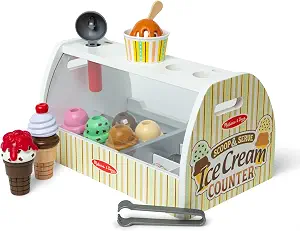
Melissa & Doug Wooden Scoop & Serve Ice Cream Counter
Check Price on Amazon
Best Overall is the editorial label for the Melissa & Doug Wooden Scoop & Serve Ice Cream Counter because its listed set brings a recognizable pretend-play premise together with many specific serving pieces. The 28-piece set includes a wooden ice cream counter, 8 scoops, 6 toppings, 2 cones, a cup, scooper, tongs, spoon, reusable menu card, and 6 bills. That combination gives a gift shopper a clear inventory to compare with the kind of pretend interaction they have in mind. It does not mean every child will prefer role-play, or that the label reflects a measured ranking.
The source lists an age range of 36 months – 6 years and wood as the material. The countertop has special ports to hold all their treats, and the counter also doubles as a toy storage box. Those are useful details for planning a play routine: a household might set up the counter for serving, then use the stated storage function afterward. Dimensions are 13.43 x 7.72 x 8.7 inches, a concrete reference when considering where the counter could sit. Check whether the actual spot works for both play and put-away rather than relying on a product name or seasonal image.
This is a practical Black Friday candidate when the intended gift is a defined pretend-serving setup rather than a collection of building pieces or a tabletop game. Compare the exact offer’s product name and included set with the listed components; do not assume that a different bundle or variant contains the same items. The set’s count alone cannot tell you how much room a child will want during play, and the stated dimensions describe the counter, not a full play area. If a reusable menu and bills suit the household’s preferred play prompt, those details can help justify a place on the shortlist. If the main priority is compact, open-ended construction, consider whether another format better matches it.
Key specs
| Included components | 28‑piece set: wooden ice cream counter, 8 scoops, 6 toppings, 2 cones, cup, scooper, tongs, spoon, reusable menu card, 6 bills |
| Age range | 36 months – 6 years |
| Material | Wood |
| Dimensions | 13.43 x 7.72 x 8.7 inches |
| Countertop features | special ports to hold all their treats |
| Storage | also doubles as a toy storage box |
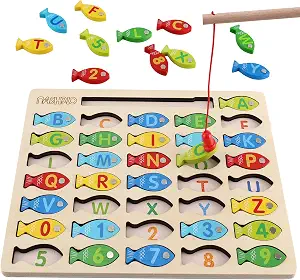
Magnetic Wooden Fishing Game Toy for Preschoolers
Check Price on Amazon
Best Budget is the supplied editorial label for the Magnetic Wooden Fishing Game Toy for Preschoolers. The label is a choice among these featured products, not a claim about its market price or a measured value. Its listed game pieces are colorful fish with different letters and numbers, and the product is described as a one-player tabletop activity for indoor use with manual operation. Those facts point to a more defined play setup than freeform building: a caregiver can weigh whether a child is drawn to handling marked pieces and taking part in a tabletop game.
Wood is the listed material, and the stated dimensions are 11.8 x 8.9 x 0.6 inches. That low-profile size gives shoppers a useful reference for considering a table or other flat play surface, but it does not establish how much surrounding room will be comfortable. The listing specifies one player, so shoppers should not assume from the available facts that the activity is designed for multiple players. The product name identifies it as a magnetic fishing game, while the supplied details do not specify further rules or a particular learning outcome. Keep expectations anchored to the information actually provided.
For Black Friday, put this option on the list if a tabletop game with labeled fish feels like a natural match for the child’s routines. Confirm that the exact product in the offer is this named item, then inspect the offer’s stated contents and variant before comparing it with another listing. The facts here establish the material, dimensions, player count, location, operation, and the fish-piece markings; they do not establish a price, promotion, storage arrangement, or age range. A shopper who wants a compact tabletop format may find the dimensions helpful, while a shopper planning shared play should treat the one-player specification as an important decision point. The Best Budget label should not replace checking the actual offer.
Key specs
| Material | Material Type Wood |
| Dimensions | Item Dimensions 11.8 x 8.9 x 0.6 inches |
| Players | Number of Players 1 |
| Play location | Play Activity Location Tabletop |
| Usage | Indoor Outdoor Usage Indoor |
| Operation | Operation Mode Manual |
| Game pieces | colorful fish pieces with different letters and numbers |
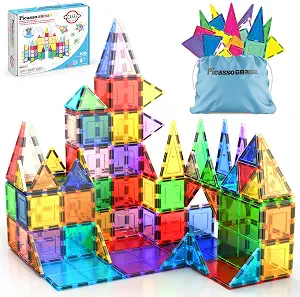
PicassoTiles 100 Piece Magnetic Tiles, Clear 3D Building Blocks for Kids 3+
Check Price on Amazon
Best for open-ended building is the editorial label for PicassoTiles 100 Piece Magnetic Tiles, Clear 3D Building Blocks for Kids 3+. The supplied specifications establish a 100-piece set and a manufacturer recommended age of 3 years and up. They identify plastic as the material, with dimensions of 14 x 11.63 x 3.13 inches and a listed item weight of 5.5 pounds. For a gift decision, these details help frame the set as a sizable collection of building pieces, while leaving the child’s preferred designs and the finished creations entirely open. The label describes the kind of play invitation suggested by building blocks, not an outcome or superiority claim.
This choice may suit a household looking for pieces that can be approached without a single serving or game premise. The available facts do not specify particular construction examples, a play surface, or the number of structures the set can make, so use the piece count as the clear comparison point rather than imagining a guaranteed result. The package dimensions can help with a storage-space check, and the listed weight may matter when deciding where to keep or carry the set. The included component is an instruction manual; the facts do not describe what it teaches or what designs it contains.
During Black Friday shopping, verify that the exact listing is the 100-piece PicassoTiles set and check that the offer identifies the same variant. A set count can be useful when comparing listings, but it does not tell you whether a child will enjoy building or how the pieces will be stored after play. The recommended age is 3 years and up, which offers a specific fit checkpoint for gift planning; it is not a substitute for considering the recipient and household. If the priority is a toy with an explicitly defined play sequence, compare that preference with the more open building premise here. Avoid treating a seasonal price presentation as proof that the set is the right fit.
Key specs
| Piece count | Number of Pieces 100 |
| Recommended age | Manufacturer recommended age 3 years and up |
| Material | Material Type Plastic |
| Dimensions | Item Dimensions 14 x 11.63 x 3.13 inches |
| Weight | Item Weight 5.5 pounds |
| Included component | Included Components Instruction Manual |
Black Friday shortlist: match the play invitation to the child
Start by picturing an ordinary play moment rather than choosing from the category name alone. The ice cream counter suggests serving pretend treats and includes a menu card and bills among its components. The fishing game is specified for one player at a tabletop and has colorful fish pieces marked with different letters and numbers. PicassoTiles offers 100 building pieces, with no single play scenario established by the supplied facts. These distinctions can help you shortlist by the kind of invitation that seems most relevant, without assuming a child will respond in a particular way.
For Black Friday, write down the priority before opening several offers: pretend serving, a defined tabletop game, or building. Then confirm the product name and exact set in each offer. Similar category words or seasonal presentation are not enough to establish identical contents. The supplied descriptions give different kinds of evidence, so compare like with like: components for the counter, player and activity details for the fishing game, and piece count for the tiles. If the child’s preferences are uncertain, choose the premise that seems easiest to introduce in the household’s usual routine, while recognizing that the specifications cannot predict enjoyment.
Treat age guidance as a checkpoint, not a complete decision
Age information is not provided for every featured item, so avoid filling in gaps by assuming that all products have the same guidance. The counter lists 36 months – 6 years; PicassoTiles lists a manufacturer recommended age of 3 years and up. No age range appears in the supplied facts for the Magnetic Wooden Fishing Game Toy. For a gift, use the stated details where they exist and check the exact product information for any item whose age guidance matters to your decision.
The distinction is especially useful when shopping for a preschooler whose age or experience makes fit an important consideration. A stated range or recommendation is a factual filter, not a prediction of how a particular child will handle or enjoy a toy. Material is another household preference: wood is listed for both the counter and fishing game, while plastic is listed for the tiles. Those descriptions do not establish durability, safety performance, or feel. During Black Friday comparisons, keep age and material as separate questions, and do not let a missing detail become an unsupported conclusion about the product.
Black Friday offer checks: compare the named set
A seasonal offer can make it tempting to compare headline wording before confirming what is actually being offered. Instead, identify the full product name and check the stated variant and components. For the counter, the provided inventory is a 28-piece set with the listed counter, scoops, toppings, serving pieces, menu card, and bills. For the fishing game, the supplied facts identify colorful fish pieces with letters and numbers, along with one-player, tabletop, indoor, and manual-use details. For PicassoTiles, the important stated count is 100 pieces, with an instruction manual listed as an included component.
These are not interchangeable ways of describing a set. A Black Friday comparison should focus on the evidence that matters for each choice, not on an assumption that product names or images guarantee matching contents. Check whether the exact offer names the product and whether its listed configuration corresponds to the item you intended to buy. The provided facts do not give current prices, promotions, or stock, so no conclusion about savings can be drawn here. If an offer leaves a detail important to your decision unclear, treat that uncertainty as a reason to verify before comparing.
Use dimensions to plan the play spot and storage
Dimensions help translate a product choice into a household plan, though they do not describe the whole area a child may use. The counter measures 13.43 x 7.72 x 8.7 inches, and the listing says it also doubles as a toy storage box. The fishing game measures 11.8 x 8.9 x 0.6 inches and is specified for tabletop play. PicassoTiles measures 14 x 11.63 x 3.13 inches, with an item weight of 5.5 pounds. Use these exact figures as reference points when considering a shelf, table, or put-away location.
For Black Friday, compare the dimensions of the item you are considering with the spot where it will realistically be used, rather than judging suitability from packaging alone. The fishing game’s stated tabletop location is a direct clue about its play setting; the counter’s storage function is a specific feature to account for after play. The supplied facts do not give storage instructions for the fishing game or tiles, nor do they say how much surrounding space a build or pretend scenario needs. Leave room for those unknowns in your planning. A practical fit is about the available surface and routine, not just whether the item can be placed in a room.
Think about how much structure suits the household
The three products supply different amounts of direction in their stated details. The ice cream counter comes with serving and pretend-money components that support a clear shop premise. The fishing game is described as a one-player manual tabletop activity, with marked fish pieces. The 100-piece building set identifies a type of play but does not prescribe a particular finished result in the provided facts. These distinctions offer a way to think about whether a child may benefit from a recognizable starting point or whether your household would rather leave the next step open.
This is not a judgment that one format is better. A defined premise can make it easier for a gift-giver to imagine how play might begin, while building pieces suggest room for varied approaches; neither description guarantees a child’s response. Consider what fits a normal afternoon: setting up a counter, using a tabletop game, or bringing out building pieces. For Black Friday, keep this preference alongside the product facts when comparing offers. Do not infer rules, educational outcomes, or social play arrangements beyond what the listing specifies. Choose based on the kind of play you want to invite, while keeping expectations modest about what the specifications can prove.
Make the final choice with household priorities in view
Before deciding, rank the considerations that matter most: a play premise the child may recognize, a stated age checkpoint, a material preference, a manageable spot, or a particular set of components. The counter provides a detailed component list, age range, dimensions, and stated storage function. The fishing game provides material, dimensions, one-player and tabletop details, and marked fish pieces. PicassoTiles provides a 100-piece count, a recommended age, material, dimensions, and weight. Each product therefore supports a different kind of practical comparison.
A Black Friday shortlist is more useful when it records both what is confirmed and what remains unknown. You can confirm listed contents and dimensions from the supplied details, but they do not establish a child’s interest, how long play will last, or how well an item fits an unmeasured space. Likewise, the editorial labels distinguish these options within this selection; they do not establish market-wide awards or tested results. Keep the choice tied to the actual product and your home’s routines. If two options meet different priorities, favor the one whose known features best address the need you care about most.
Make your Black Friday choice
The best preschool toy choice here depends on the play invitation and household setup you want to support: pretend serving, a one-player tabletop game, or open-ended building. Use the stated components, age guidance, materials, and dimensions as evidence, while leaving unverified qualities open. During Black Friday, confirm the exact product and set before comparing offers; a seasonal label alone cannot establish a better fit or a saving. The counter, fishing game, and tiles each provide a distinct starting point for a practical shortlist, not a guarantee of how a child will play.