Power Equipment 4400 Watts Inverter Generator Gas Powered
Westinghouse 12500 Watt Dual Fuel Home Backup Portable Generator, Remote Electric Start, Transfer Switch Ready, Gas and Propane Powered
Westinghouse 14500 Peak Watt Tri-Fuel Home Backup Portable Generator
Best Generator Buying Guide — Black Friday Deals 2026
Choosing a generator starts with the equipment and fuel you expect to use, not the biggest wattage printed in a listing. This guide covers three distinct configurations: a gasoline inverter generator, a dual-fuel home-backup model and a tri-fuel option. Their output, outlets and operating details address different planning needs, so compare those facts against your own intended setup. During Black Friday, a deal headline is only a starting point: check that the exact model and configuration match the product you researched, then compare the offer on its full terms. No sale price or promotion is assumed here.
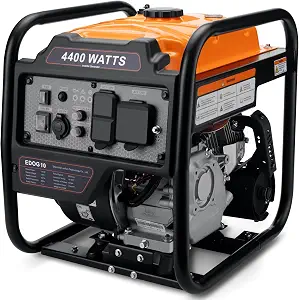
Power Equipment 4400 Watts Inverter Generator Gas Powered
Check Price on Amazon
The Power Equipment 4400 Watts Inverter Generator is the Best Budget pick in this guide, based on its comparatively contained listed output and two-gallon tank—not on a claim about its current price. Treat the label as an editorial way to describe its place among these choices. Before buying, check the Black Friday offer for the exact product and confirm that its specifications fit your intended use.
This gasoline-powered model is specified at 4400 peak watts and 3400 running watts. Those figures serve different planning purposes: consider the running figure when identifying the equipment you expect to power during normal operation, and account separately for any starting demand shown on appliance labels or manuals. Do not treat peak output as a substitute for a running-load plan. If the equipment you have in mind needs more than the listed running output, this model may not suit that plan; a different set of loads could make its output more appropriate.
Its listed connections are 2*120V AC ports, 1*12V DC port and 1*RV port. Map the plugs on your intended equipment to those outlet types before deciding. The presence of an RV port may be relevant if your plan involves an RV connection, but the supplied details do not specify compatibility with every RV or cable arrangement. Check the exact connection requirements for your equipment rather than relying on a general category label.
The two-gallon gasoline tank, weight of 56 pounds and noise specification of under 72 dBA from 23FT away are useful practical details to weigh together. A smaller stated tank is a reason to think carefully about how you would manage fuel for your expected use; no runtime is provided here, so do not infer how long a fill will last. Consider whether the stated weight suits your storage and handling plans, and interpret the noise figure with its stated distance attached. During Black Friday, compare those exact details with the listing, not just a promotional headline.
This option makes most sense for a shopper whose planned connections and load fit its listed output, who wants gasoline as the specified fuel, and who values the listed inverter configuration. The supplied facts do not state runtime, starting method or additional features, so verify any detail important to your decision on the exact listing. A careful match between equipment, outlets and fuel plan is a stronger reason to choose it than an assumed discount.
Key specs
| Power output | 4400 peak watts and 3400 running watts |
| Fuel | Gasoline |
| Outlets | 2*120V AC ports, 1*12V DC port, 1*RV port |
| Fuel tank | 2 gallon fuel tank |
| Noise level | Under 72 dBA from 23FT away |
| Weight | 56 pounds |
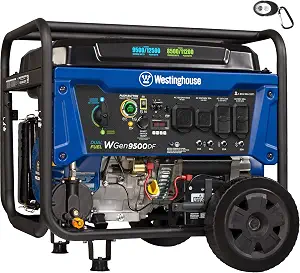
Westinghouse 12500 Watt Dual Fuel Home Backup Portable Generator, Remote Electric Start, Transfer Switch Ready, Gas and Propane Powered
Check Price on Amazon
The Westinghouse 12500 Watt Dual Fuel Home Backup Portable Generator earns the Best Overall label among these three options as an editorial choice: its listed output, two fuel choices, several outlet types and multiple starting methods give shoppers several planning factors to evaluate in one model. That label is not a test result or a claim of superiority over generators beyond this guide. For Black Friday, verify the exact model and fuel-related configuration in the offer before comparing it with alternatives.
On gasoline, the generator is rated at 9500 running watts and 12500 peak watts; on propane, it is specified at 8500 running watts and 11200 peak watts. Plan around the appropriate figures for the fuel you expect to use. Start with the equipment you intend to run, noting its stated operating and starting requirements, and avoid assuming that the gasoline figures apply when using propane. If you may switch fuels, make separate load plans rather than combining the two sets of output numbers.
The model offers remote start with an included key fob, electric start and recoil start. That range of listed starting methods may matter to someone deciding how they want to operate a backup generator, but it does not remove the need to check the instructions and setup requirements for the exact model. The supplied runtime is up to 12 hours, and the tank volume is 6.6 gallons. Since the stated runtime is qualified as ‘up to,’ treat it as a listing specification rather than a promise for every load or operating situation.
Its outlet selection includes two GFCI 120V 5–20R 20A standard household receptacles, one transfer-switch-ready 120V L14-30R 30A outlet and one RV-ready 120/240V 14–50R 50A outlet. These descriptions can help you compare the generator with a planned connection route, but they do not establish that a particular installation or device will work without checking its requirements. Transfer-switch-ready is a useful detail to investigate, not a substitute for confirming the equipment and installation plan.
The listed engine is a heavy-duty 457cc Westinghouse 4-stroke OHV engine, with a cast iron sleeve, automatic low oil shutdown and digital hour meter. If these details matter to your decision, compare them against the full Black Friday listing and instructions. This model suits a shopper who can use its output and outlets, has a workable gasoline or propane plan, and values the listed starting choices. Verify the complete offer and exact variant rather than assuming a deal includes anything beyond the stated generator.
Key specs
| Power output | 9500 Running Watts and 12500 Peak Watts (Gasoline); 8500 Running Watts, 11200 Peak Watts (Propane) |
| Starting | Remote Start with Included Key Fob, Electric and Recoil Start |
| Runtime | Up to 12 Hours of Run Time |
| Fuel tank | Tank Volume 6.6 gallons |
| Outlets | Two GFCI 120V 5–20R 20A Standard Household Receptacle, One Transfer Switch Ready 120V L14-30R 30A, and One RV Ready 120/240V 14–50R 50A |
| Engine | Heavy Duty 457cc Westinghouse 4-Stroke OHV Engine Featuring a Long-Lasting Cast Iron Sleeve with Automatic Low Oil Shutdown and Digital Hour Meter |
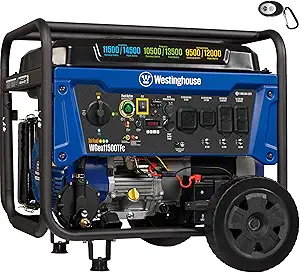
Westinghouse 14500 Peak Watt Tri-Fuel Home Backup Portable Generator
Check Price on Amazon
The Westinghouse 14500 Peak Watt Tri-Fuel Home Backup Portable Generator is the Best for Fuel Flexibility choice because its listed fuel types are gasoline, liquefied petroleum gas and natural gas. The label reflects that specific choice, not a claim about comparative performance or availability. On Black Friday, confirm that the exact model in the offer is this tri-fuel product, then examine the details that matter to your own fuel supply and connection plan.
Its stated output on gasoline is 11,500 running watts and 14,500 peak watts. The supplied facts do not give corresponding output figures for liquefied petroleum gas or natural gas, so do not carry the gasoline ratings over to those fuels. If you expect to use a fuel other than gasoline, check the exact listing and product information for the applicable output before building a load plan. Match the relevant operating and starting needs of your equipment to the figures for the fuel you intend to use.
The product details identify 50A and 30A outlets and say they pair well with an interlock kit, manual transfer switch or Westinghouse WATS200 ATS system for home backup; those items are sold separately. This makes it especially important to plan the whole connection route instead of choosing by outlet labels alone. Confirm that your intended equipment and setup use the connection you have in mind, and account for the separately sold items if they are part of your plan. Do not treat an outlet description as confirmation that a specific installation is already included.
Space and handling deserve attention too. The listed dimensions are 27.2"L x 26.1"W x 26.5"H, and the listed weight is 230 pounds. Compare the dimensions in their original format with your intended storage and placement area, and consider the weight when planning how the unit will be handled. The supplied facts do not state runtime or starting method, so shoppers who need those details should check them on the exact product listing rather than infer them from the fuel choices or home-backup description.
This generator is a candidate for a household backup plan where choosing among the three specified fuel types is a priority and the listed 30A or 50A connections suit the intended route. The tradeoff is that the buyer still needs to verify fuel-specific output, space, handling and any separately sold connection equipment. Compare the Black Friday offer against those requirements and the exact product details; a broad tri-fuel headline alone does not answer whether the configuration fits your circumstances.
Key specs
| Fuel options | Fuel Type Gasoline, Liquefied Petroleum Gas, Natural Gas |
| Running and peak wattage | Delivers 11,500 running/14,500 peak watts on gasoline. |
| Outlets and home backup | 50A and 30A outlets pair well with an interlock kit, manual transfer switch or Westinghouse WATS200 ATS system for home backup (sold separately). |
| Dimensions | 27.2"L x 26.1"W x 26.5"H |
| Weight | 230 pounds |
Translate your equipment list into a workable power plan
Before comparing generators, write down the equipment you actually expect to run and find the operating and starting requirements stated for each item. Use those requirements to decide which loads matter most and whether they would be used together. Then compare the plan with the generator’s running output, keeping peak output distinct rather than treating the larger number as the amount available for continuous use. This step can rule out a mismatch before a Black Friday headline distracts from the specifications.
For the dual-fuel Westinghouse, create separate plans for gasoline and propane because the listed output differs by fuel. The tri-fuel model gives a gasoline output figure, but its supplied details do not provide equivalent figures for the other two fuels. The inverter model lists both peak and running output, which also need to remain separate in your comparison. If a key appliance’s requirements or the generator’s relevant output is unclear, pause and check the exact product information rather than filling the gap with an assumption.
A realistic plan also accounts for what you will leave unplugged. Decide which equipment is essential for the intended scenario and whether the listed outlet types can serve it. A generator can have an appealing headline wattage yet still be an awkward fit for a particular connection plan. During Black Friday, compare the exact model against this written list, not against a vague idea of how much power a household might need.
Follow outlet types through the intended connection
Outlet labels are most useful when you already know what connects to them. Check the plug and connection requirements of each intended device, then identify whether the generator lists an outlet that matches the route you plan to use. The compact inverter model lists two 120V AC ports, a 12V DC port and an RV port. The dual-fuel model lists household receptacles as well as L14-30R and 14-50R outlets. The tri-fuel model’s supplied details identify 30A and 50A outlets, while noting possible home-backup arrangements.
Those descriptions are not interchangeable, and an outlet’s presence alone does not confirm that every appliance, cable or home connection is suitable. In particular, the dual-fuel model’s transfer-switch-ready outlet and the tri-fuel model’s stated pairing with an interlock kit, manual transfer switch or named ATS system should prompt a closer look at the complete setup. The tri-fuel listing says the referenced home-backup equipment is sold separately. Check what is actually included in the exact offer and what the rest of your connection plan requires.
Make a simple route for each important load: device, required connection and generator outlet. If one part of that route is uncertain, verify it before checkout. Black Friday comparisons are easier when you distinguish a useful outlet specification from a confirmed fit for your particular equipment. Avoid choosing solely because a listing mentions an RV or home-backup connection; compare the exact outlet designation and your own requirements.
Choose fuel based on a supply you can actually plan around
Fuel flexibility is valuable only when it fits the way you expect to obtain and use fuel. The Power Equipment model lists gasoline. The Westinghouse dual-fuel model lists gasoline and propane, with separate output figures for each. The tri-fuel model lists gasoline, liquefied petroleum gas and natural gas, but the provided output figure applies to gasoline only. These are meaningful differences to consider, not a guarantee that every fuel will be equally convenient in every location.
Think through which fuel you expect to use, whether that choice suits your intended routine, and which model specifications apply to it. For the dual-fuel option, compare the relevant gasoline or propane output with your equipment plan. For the tri-fuel option, seek the applicable figures for a non-gasoline fuel before relying on it for a particular load. Do not assume that switching fuels leaves output unchanged when the supplied facts do not say so.
Black Friday listings can make a fuel feature prominent, so check that the exact offer describes the same model and fuel configuration you meant to compare. Treat fuel type as part of the decision alongside output, outlets and storage—not as a shortcut for choosing. A clear plan for the supply you intend to use is more useful than counting fuel options without checking their relevance.
Account for space, weight and the details you will use
Where a generator will be stored and how it will be handled can affect whether a specification fits your routine. The inverter model is listed at 56 pounds, while the tri-fuel model is listed at 230 pounds and includes dimensions of 27.2"L x 26.1"W x 26.5"H. Consider the available storage space and how you would move or position the unit. Do not assume that a weight figure tells you how the generator is packaged or what handling equipment is included.
The gasoline inverter model also lists a noise level of under 72 dBA from 23FT away. Keep that qualification intact when deciding whether the figure is relevant to your intended placement; it does not describe every distance or situation. The dual-fuel model lists a 6.6-gallon tank and up to 12 hours of runtime. Because the runtime is stated as ‘up to,’ use it as a qualified specification rather than a guaranteed duration for your particular use. The inverter’s two-gallon tank is listed, but no runtime is provided in these facts.
Starting and operating details may matter just as much as storage. The dual-fuel generator specifies remote start with an included key fob, electric start and recoil start. Its listed engine details include automatic low oil shutdown and a digital hour meter. If these features are priorities, verify that the exact Black Friday offer is for the model described and read the product information for any operating details you need. Do not infer missing features from another model’s listing.
Compare the complete Black Friday offer, not just its headline
A useful offer comparison begins with identity: confirm the model name and exact configuration, then check the listed fuel type, output and outlets against your notes. A Black Friday banner does not establish that the featured product matches the version you researched, nor does it tell you whether separately sold equipment is part of the offer. For the tri-fuel generator, for example, the listed home-backup accessories are sold separately. Check the offer details rather than assuming they are bundled.
Next, compare specifications that shape daily decisions. Is the relevant running output stated for your chosen fuel? Do the outlets match the route to your equipment? Are runtime, tank volume, weight, dimensions, starting methods or noise details important to your plan—and are they actually given for that model? The three products do not share identical information, so avoid filling omissions with another product’s specifications. If a detail is essential and unclear, verify it before treating the offer as a match.
Finally, compare the offer itself on the terms shown at the time you shop. No particular discount, price or availability is assumed in this guide. Keep the product’s practical fit separate from any promotional language: a compelling headline cannot make an unsuitable outlet or fuel plan work for you. The strongest Black Friday shortlist is one where the exact product, its relevant specifications and the complete offer all align with your intended use.
Make your Black Friday choice
These generators suit different priorities: the gasoline inverter model offers a listed 3400 running watts and a range of outlet types; the dual-fuel model combines specified gasoline and propane outputs with several starting methods; and the tri-fuel model lists three fuel types alongside 30A and 50A outlets for a home-backup connection plan. Start with your equipment, fuel supply and connection route, then check the relevant specifications and practical constraints. When Black Friday arrives, verify the exact model and full offer rather than assuming a headline tells the whole story. Choose the configuration that fits your plan—not simply the one with the largest number or broadest label.